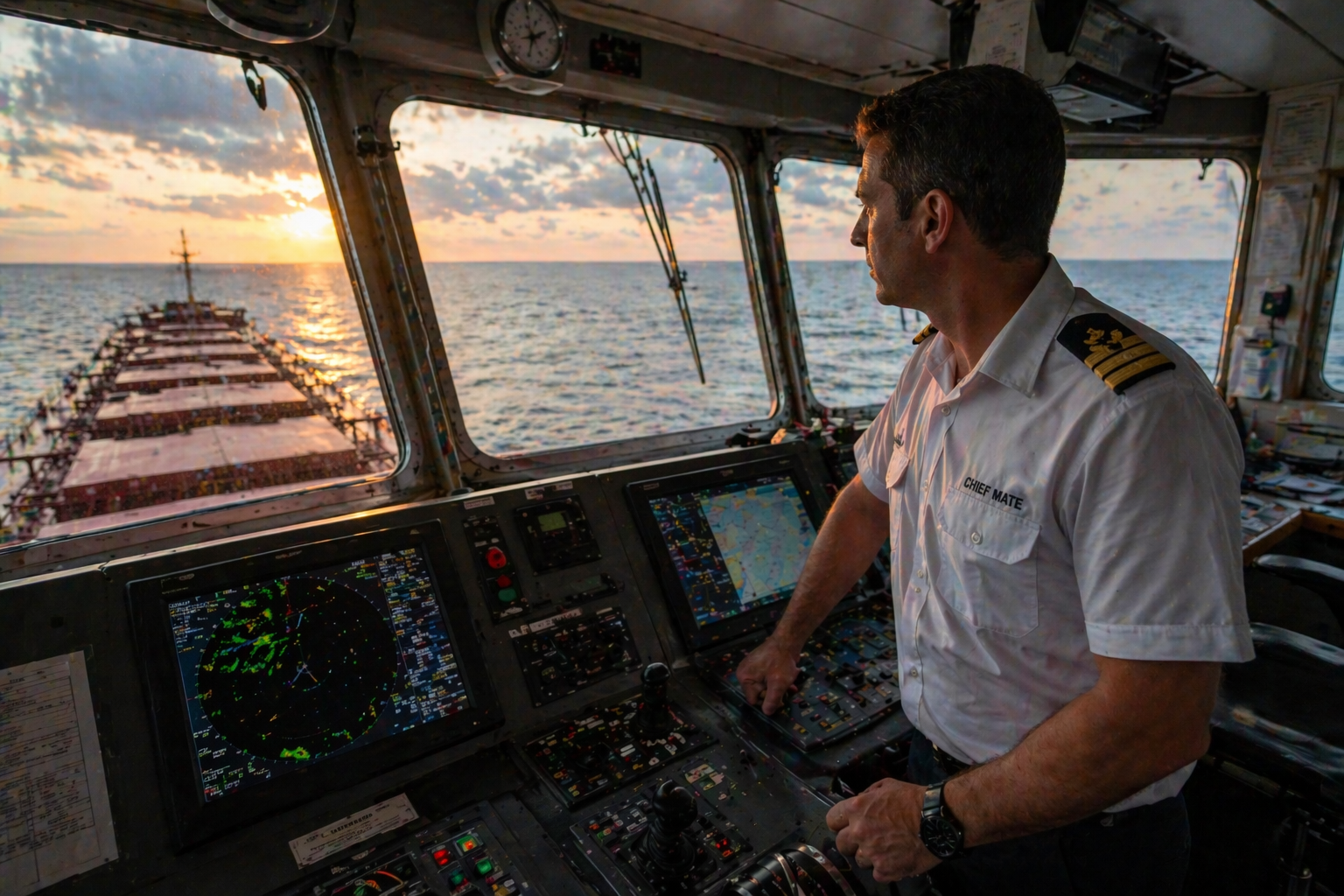
The chief mate, also called the chief officer, on a bulk carrier carries more operational responsibility than the equivalent rank on most other vessel types. The cargo work is complex, the maintenance demands are continuous, and the department management load is real.
Here is what the job actually involves.
Cargo Operations
This is the central responsibility that distinguishes chief officer work on a bulk carrier from other sectors. Every cargo operation starts and ends with the chief officer.
Before arrival at the loading port: preparing the cargo plan. Working out which holds receive which quantities to achieve the required stability, maintain acceptable hull stress throughout loading, and comply with any charterer or shipper requirements about cargo distribution. On a large bulk carrier loading 150,000 tonnes of iron ore, getting this wrong has structural consequences.
During loading: supervising the operation, monitoring tank gauges and hold weights, adjusting the loading sequence if the shore conveyor rate differs from plan, coordinating with the port superintendent and surveyor. Draught surveys are conducted at various points during loading. The chief officer reads the vessel’s draught marks and uses the survey to verify cargo quantity. This is the basis for the bill of lading figure. It needs to be accurate.
Between cargo operations: hold cleaning and preparation for the next cargo. The standard required depends on what the next cargo is. Grain cargoes require a higher level of cleanliness than bulk fertiliser, for example. Surveyors inspect holds on behalf of the charterer before loading and the chief officer is responsible for presenting holds that pass.
After discharge: assessing hold condition for damage claims, inspecting hatch covers and tank tops, preparing for the next voyage.
Maintenance
The chief officer is responsible for the maintenance of the entire deck department and its equipment. Hatch covers are the priority. They are expensive to repair and their failure has significant consequences. A comprehensive planned maintenance programme covering hatch cover mechanisms, seals, drainage and coaming condition is the chief officer’s responsibility.
Deck machinery: cranes on geared vessels, mooring winches, windlass, anchors, emergency equipment. All of it sits under the chief officer’s oversight.
Hull maintenance: the ongoing rust prevention programme, coating condition monitoring, damage reporting. On a bulk carrier that works hard, the hull deteriorates faster than on some other vessel types and the maintenance programme needs to reflect that.
Crew Management
The deck department on a bulk carrier typically includes the second officer, third officer, bosun, four to six ABs and one or two ordinary seamen. The chief officer manages this group.
Performance reporting, leave scheduling, duty allocation, managing interpersonal issues that arise when people live and work together for months at a time. None of this is unique to bulk carriers but it is a consistent part of the job that gets less attention in officer training than the technical responsibilities.
Chief officers who manage their departments well have fewer problems with morale, maintenance standards and operational errors. Chief officers who do not tend to find that the technical problems multiply because the human side is not working.
Earnings
Monthly contract rates for chief officers on bulk carriers:
Handysize and Supramax: $5,500 to $7,500. The range reflects operator quality, flag and the officer’s experience level.
Panamax and Kamsarmax: $6,000 to $8,500.
Capesize: $7,000 to $10,000. The scale premium applies clearly at this rank. A chief officer responsible for cargo operations involving 150,000 to 200,000 tonnes of cargo with a major operator earns at the higher end.
Leave periods are typically two to three months for a four to six month contract. The annual income calculation matters more than the monthly figure. A chief officer on $7,000 per month on a five month contract with three months off earns $42,000 for that cycle. Two cycles per year produces $84,000 annually before any tax considerations.
The Path From Chief Officer to Master
The chief officer position on a bulk carrier is where command readiness is built. Masters are looking for chief officers who can manage the vessel’s cargo operations independently, who handle the department competently and who show good judgment under pressure.
Officers who use the chief officer position to genuinely develop their understanding of the master’s commercial and legal responsibilities move toward command faster than those who treat it purely as a technical stepping stone.
Command positions on bulk carriers become available when masters retire, when fleets expand, or when officers move to other vessel types. The timeline from chief officer to master is unpredictable. Some officers wait three years. Some wait ten. Building the right reputation with the right operators is the factor most within the officer’s own control.