
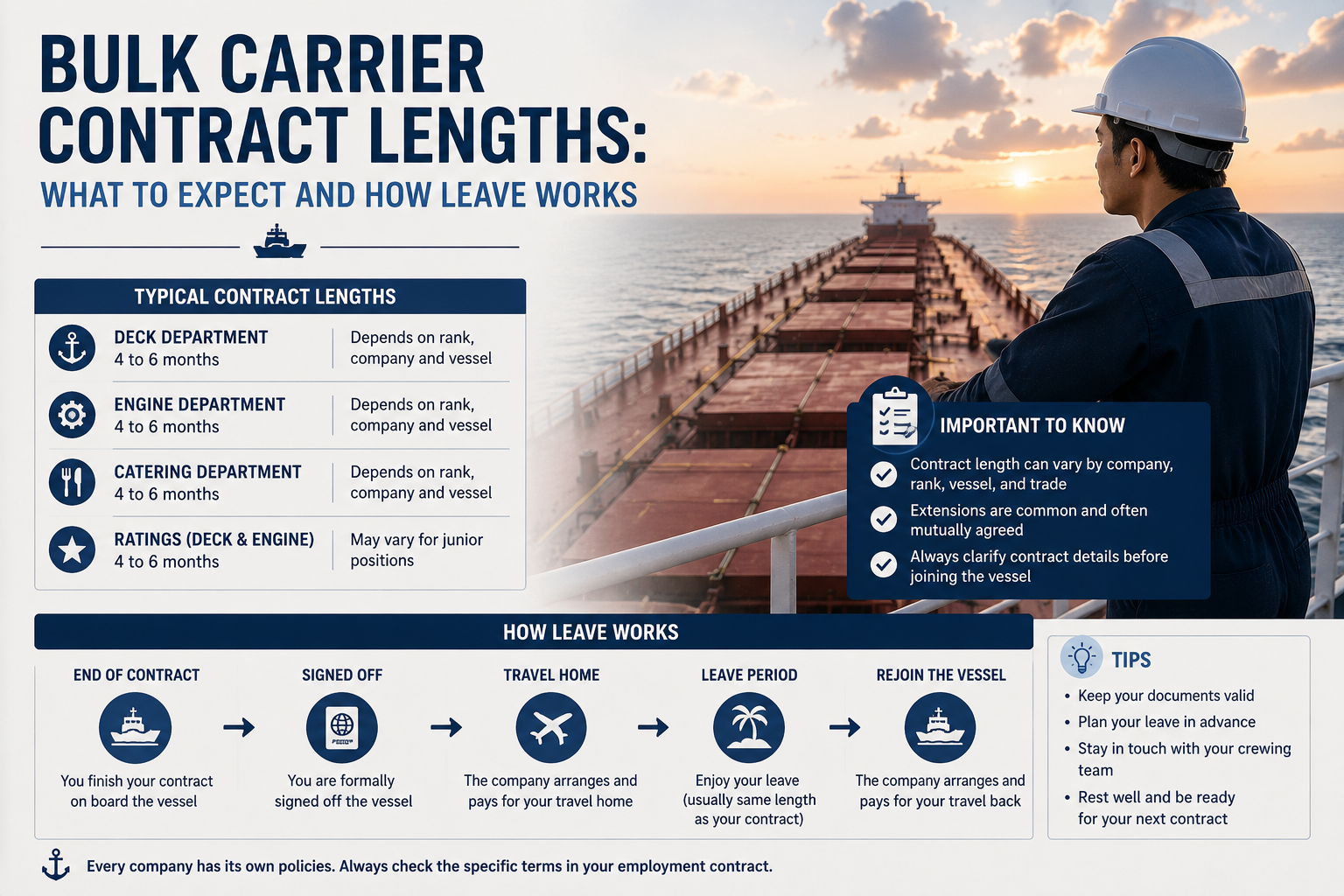
Bulk Carrier Contract Lengths: What to Expect and How Leave Works
Contract lengths on bulk carriers follow patterns shaped by the type of operation, the vessel’s flag and the nationality of the crew. Understanding the typical structure before signing helps avoid surprises.
**Standard Contract Lengths**
Officers: four to six months on board. Some operators run shorter contracts of three months for senior officers. Some run longer up to seven months in specific trading regions where crew change logistics are difficult.
Ratings: six to nine months. The longer contracts for ratings reflect the cost structure of crew changes relative to the salary level. A shorter contract for a lower-paid position means crew change costs represent a higher proportion of the total employment cost.
**What Drives the Variation**
Crew change port availability. A vessel cycling between Australian grain ports and Asian discharge ports can change crew efficiently in Singapore or Japan. A vessel on an irregular tramp voyage may go months between accessible crew change points.
Flag state requirements. Some flag states specify maximum contract lengths. Others leave it to the employment contract. The MLC sets the outer limit at eleven months for any single contract.
**Leave After the Contract**
The leave ratio varies by operator. The industry reference point is one month of leave for each month on board. Better operators with strong collective agreements maintain this or exceed it. Operators at the lower end of the market compress leave to the minimum that retains crew.
Three months of leave after a six-month contract on a standard agreement. Two months after a five-month contract at lower ratios. The variation affects the annual income calculation more than the monthly rate does.
**The Practical Implication**
A master earning $10,000 per month on a six-month contract with three months leave earns $60,000 from that contract. The same master on two shorter four-month contracts with two months leave between them earns $80,000 in the same twelve months.
Contract frequency matters as much as contract length for annual income. Officers who manage their availability and maintain active relationships with crewing managers between contracts work more months per year than those who wait for the phone to ring.