
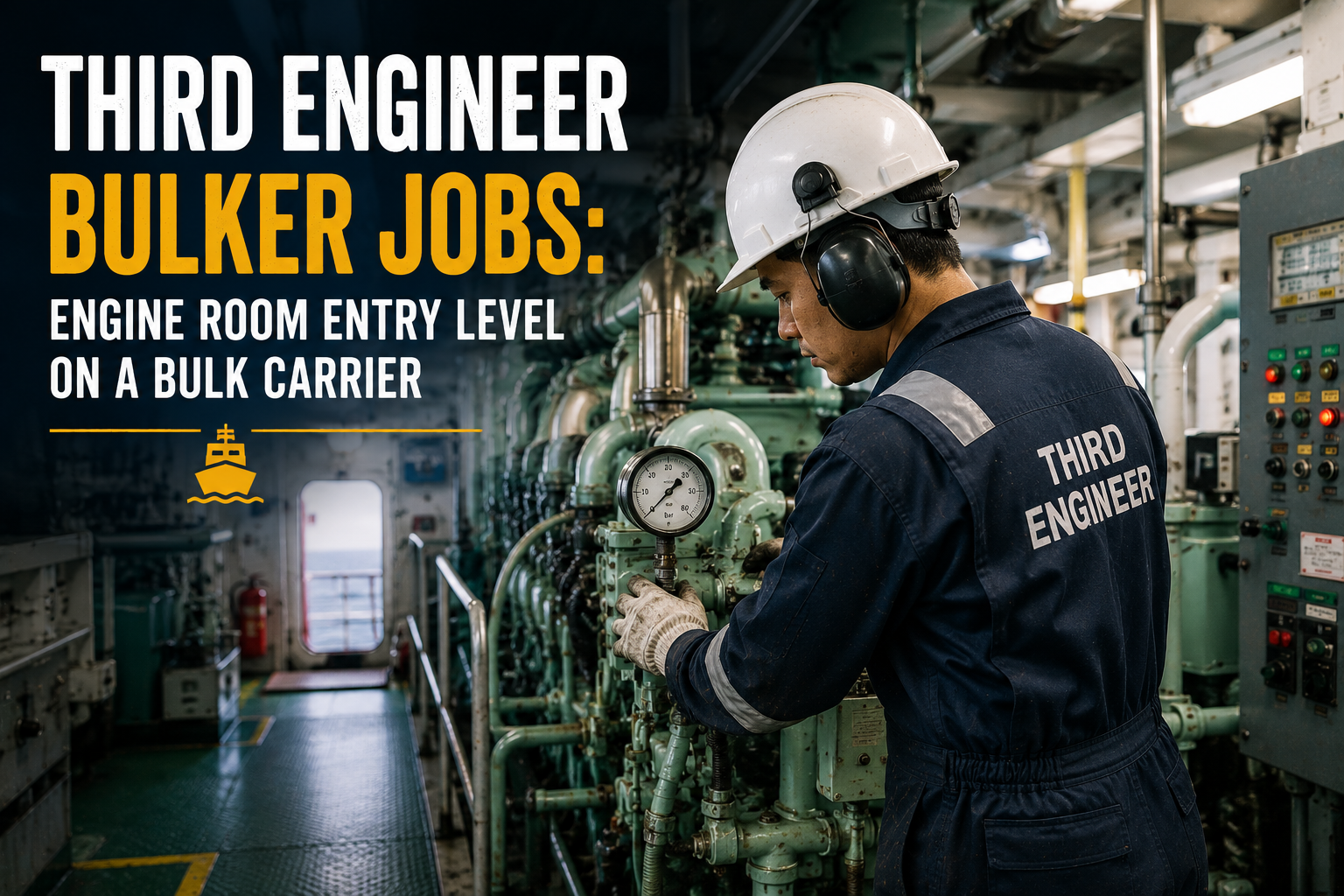
Third Engineer Bulker Jobs: Engine Room Entry Level on a Bulk Carrier
The third engineer is the first officer rank in the engine department. On a bulk carrier the role provides a practical education in marine engineering systems that the cadetship introduces theoretically but only sea service makes real.
**What the Third Engineer Owns**
Auxiliary systems. Boilers on steam-equipped vessels. Freshwater generators. Air compressors. Sewage treatment. Bilge systems. These are the systems the third engineer is typically assigned primary responsibility for, working within the second engineer’s planned maintenance schedule.
The scope varies by vessel and by operator. On a lean crew vessel the third engineer may cover more ground. On a well-staffed ship the systems assigned are narrower and deeper.
Engine room watchkeeping is the other half of the role. Four on, eight off. Monitoring running parameters, responding to alarms, logging readings in the engine room log.
**The Learning Curve**
The difference between knowing the theory and knowing the machine becomes immediately clear in the first weeks. A freshwater generator that trips repeatedly for reasons the textbook does not cover is the kind of practical problem that the third engineer learns to diagnose through observation and logic rather than looking up the answer.
Officers who use the third engineer period to actively understand the systems they are responsible for, rather than managing them reactively, progress to second engineer in better shape.
**Pay**
$3,500 to $5,500 per month on bulk carriers. Higher on tankers. Higher still on gas carriers. The incentive structure for specialising in tankers or gas exists at this rank as much as at any other.
**The Next Step**
Second engineer certificate requires additional sea time and a management-level examination. Officers who prepare for this during the third engineer period rather than after accumulating the minimum sea time are more efficient in reaching it.